The Skin & Joint Injection ClinicSeborrhoeic keratosis removal · Wirral
Seborrhoeic Keratosis Removal in Wirral
Treatment of suitable benign 'stuck-on' age-related lesions.
Treatment of suitable benign 'stuck-on' age-related lesions.
A careful, considered approach to your skin
Seborrhoeic keratoses are the small, waxy or warty patches that seem to quietly appear with age, often on the face, scalp, neckline or back. They have a distinctive "stuck-on" look, as if you could lift them off with a fingernail. Many patients first notice one in a holiday photograph and ask, quite reasonably, whether it can simply be removed.
Although seborrhoeic keratoses are harmless, they can catch on clothing, itch, become inflamed when rubbed, or sit somewhere visible enough that they start to bother you. At our private Wirral clinic we examine the lesion carefully, confirm the diagnosis, and where suitable remove it using the gentlest technique that matches the lesion and its location.
Seborrhoeic keratosis removal (up to 3 lesions)
From£200
Includes consultation, in-clinic treatment of up to three lesions and aftercare. Larger or atypical lesions may need a different pathway, which we'll discuss at consultation.
A seborrhoeic keratosis is a non-cancerous overgrowth of the outer layer of the skin (epidermis). It often appears slowly over months, then stays stable for years. Typical features include:
A "stuck-on" or "wax-drop" appearance
A rough, slightly warty or scaly surface
A colour anywhere from pale tan to dark brown or near-black
A well-defined edge against the normal skin
Common locations: face, scalp, chest, back and shoulders
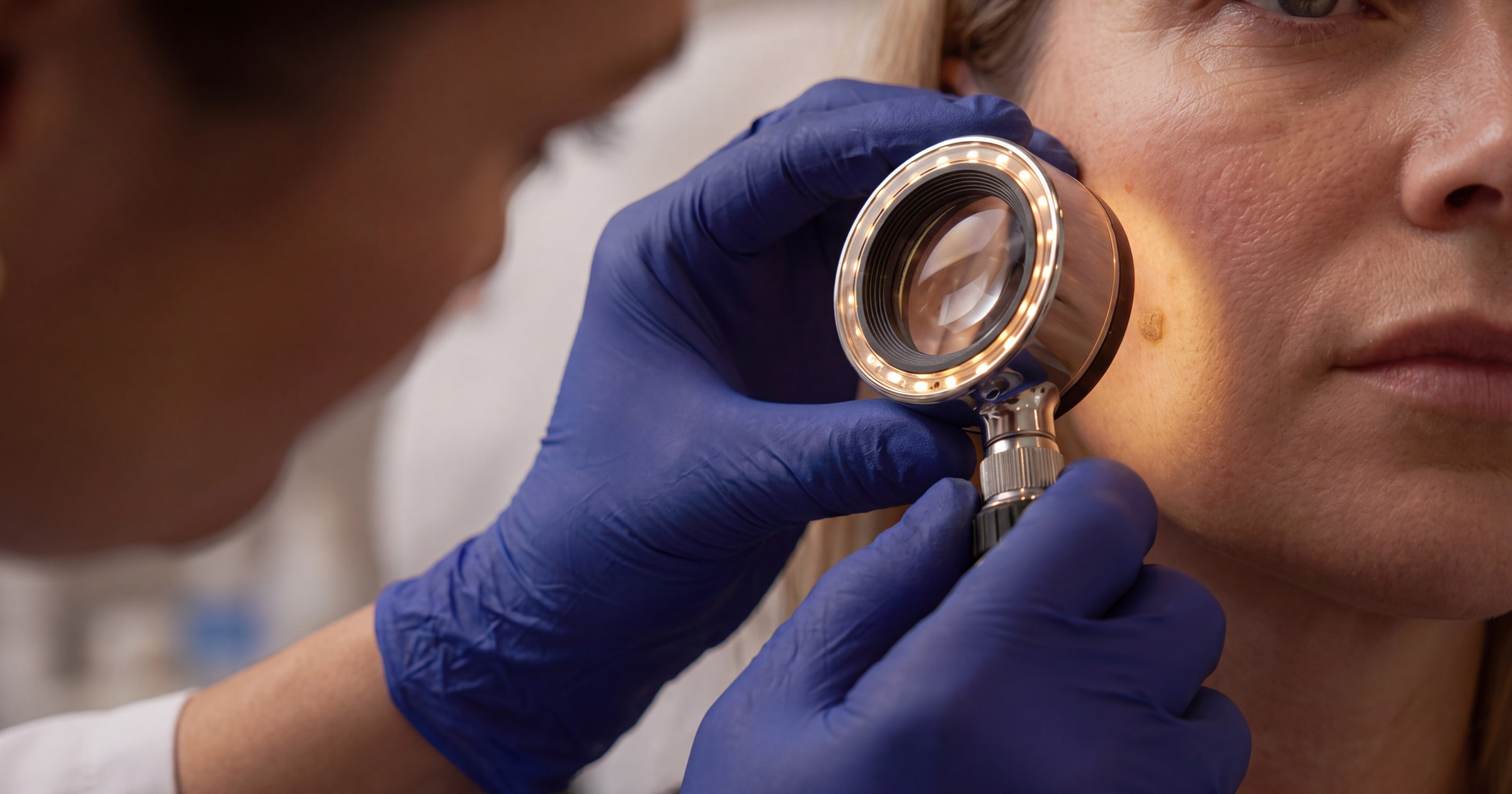
Despite their dark colour, seborrhoeic keratoses are not moles and are unrelated to melanoma. However, because pigmented lesions can occasionally be hard to tell apart on visual inspection, careful examination, usually with a , is important before any removal.
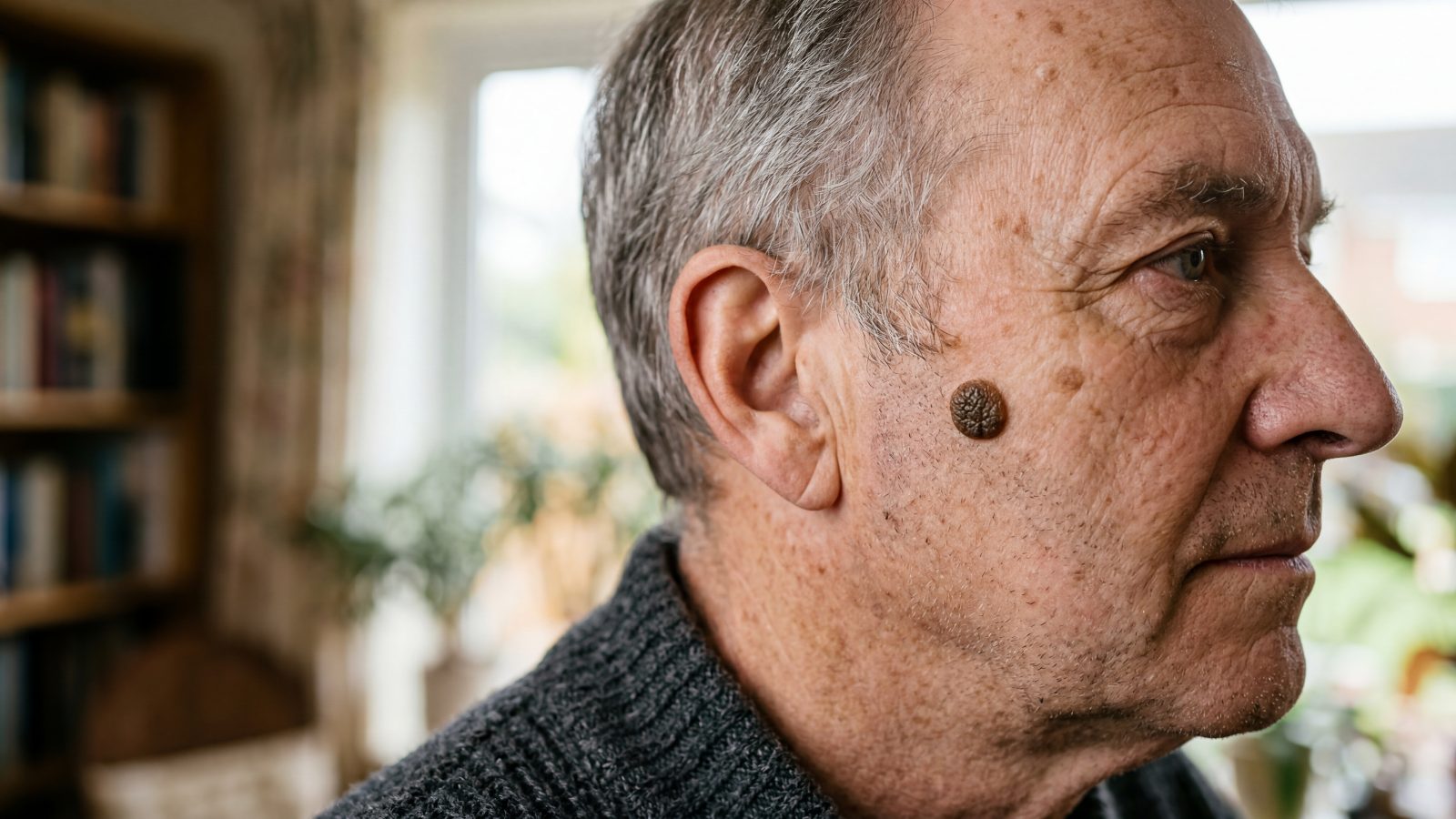
A typical seborrhoeic keratosis on the cheek: stuck-on in appearance with a slightly warty surface.
Suitability
When removal may be considered
Removal may be considered when a seborrhoeic keratosis is:
Repeatedly catching on clothing, jewellery or a hairbrush
Inflamed, itchy or sore from rubbing
In a position that you find cosmetically intrusive
Crusting or scabbing because of repeated minor trauma
Causing you persistent worry, despite reassurance, because of its dark colour
Treatment of seborrhoeic keratoses is generally not available on the NHS as they are benign, which is why most people who want them removed choose private treatment.
Your visit
Assessment and suitability
The key part of the consultation is confirming that the lesion is consistent with a benign seborrhoeic keratosis and not something that could mimic one, including pigmented basal cell carcinoma, lentigo maligna or melanoma. We use a dermatoscope to support the visual assessment.
We only treat lesions that we judge to be benign and suitable for cosmetic removal. Any pigmented lesion where there is meaningful diagnostic uncertainty is referred back to your NHS GP for dermatology review rather than removed privately. We do not diagnose lesions online.
The procedure
How seborrhoeic keratoses are treated
Several techniques can be used. The choice depends on the thickness of the lesion, its size, its location, and the cosmetic outcome we are aiming for.
Curettage. The surface of the lesion is gently scraped away with a small spoon-shaped instrument under local anaesthetic. Suitable for many flatter lesions.
Shave excision. The lesion is shaved off level with the skin under local anaesthetic, useful for thicker keratoses.
Electrosurgery / cautery. A small electric current is used to remove the lesion and seal the base, useful for smaller or vascular lesions and bleeding control.
Where it is clinically appropriate, removed tissue may be sent for histopathology as a safety check; this is discussed and agreed at consultation.
Aftercare
Recovery and aftercare
Recovery is usually straightforward. We give you written aftercare advice covering:
Keeping the area clean and dry for 24–48 hours
Avoiding scratching or picking the small scab that forms
Avoiding swimming and saunas until any scab has separated
Sun protection of the treated area to support a better cosmetic result and reduce post-inflammatory pigmentation
When to call us if redness or discharge develops
Small scabs typically separate within 1–2 weeks. The treated area may initially appear pink and lighter than the surrounding skin and gradually settles over weeks to months.
Honest about risks
Risks and limitations
No skin procedure is risk-free. We will discuss the specific risks for your lesion at consultation. General risks include:
A flat pale or slightly pink mark at the treated site. A scar-free result cannot be guaranteed
Post-inflammatory pigmentation change (lighter or darker) in the surrounding skin, particularly in darker skin types
Minor bleeding, infection or delayed healing
Recurrence of the lesion if treatment is superficial
Development of new seborrhoeic keratoses elsewhere over time
Rarely, an unexpected histology result requiring further specialist input
Important safety information
When to seek urgent assessment
Please see your NHS GP urgently before booking cosmetic removal if a pigmented or "stuck-on" looking lesion is:
Changing in size, shape or colour
Becoming asymmetrical or multi-coloured
Bleeding spontaneously or developing a non-healing sore
Itching, burning or becoming persistently sore without obvious reason
Appearing suddenly and growing quickly
These features can indicate skin cancer and require NHS assessment rather than cosmetic private removal. A sudden eruption of many new seborrhoeic keratoses in an older adult, sometimes called the sign of Leser-Trélat, is rare but warrants GP review.
Ready to take the next step?
Book a consultation in Wirral
Our private clinic in Higher Bebington, Wirral serves patients from across Merseyside, including Liverpool, Birkenhead, Heswall and Chester. We examine the lesion in person before discussing whether removal is the right choice for you.
Assessment, treatment and aftercare, clearly explained.
We know it can feel difficult to book a procedure when you are not sure what will happen next. Your clinician will explain suitability, risks, recovery and aftercare before treatment goes ahead.
Book
Choose a consultation online or speak to the clinic if you are not sure which service fits. Most appointments are available within seven days.
Assess
An in-person review with Dr Mugerwa: he will listen to your story and examine the area, which may include an ultrasound scan. You then get an honest recommendation — if treatment is suitable we explain the options, risks and likely outcomes; if it is not, we will tell you and refer you on.
Treat
The procedure itself, followed by tailored aftercare guidance and a clear contact route if anything changes during recovery.
“Had a seborrhoeic keratosis wart removed from my forehead, Soul is very professional and put me at ease. Procedure was painless and over with quickly. Really pleased with the outcome, thank you.”
Frequently asked
Your questions, answered
Are seborrhoeic keratoses cancerous?
No. Seborrhoeic keratoses are benign. They do not turn into skin cancer. However, pigmented skin cancers can occasionally look like them, which is why every lesion is examined carefully before any treatment.
Will the lesion come back?
Once an individual seborrhoeic keratosis has been fully removed it does not usually recur at exactly the same site. New ones can appear elsewhere over time, which is part of the normal pattern of these lesions.
Can you remove several in one visit?
Yes, often. The number that can be safely treated together depends on the size and location of each lesion and the total amount of local anaesthetic used. We agree a treatment plan at your consultation.
Will the area where it was removed look obvious?
The treated area is usually flatter and slightly paler or pinker than the surrounding skin initially, and gradually blends in over weeks to months. We cannot guarantee a scar-free result.
How much does removal cost?
Fees depend on the number, size and location of lesions and the technique used. Please see the pricing page for current rates.