The Skin & Joint Injection ClinicMole removal · Wirral
Mole Removal in Wirral
Assessment and removal of suitable benign moles.
Assessment and removal of suitable benign moles.
A careful, considered approach to your skin
Most moles are completely harmless, but living with one that catches on a collar, shaves awkwardly, or sits exactly where you cannot stop noticing it can quietly chip away at confidence. If you have been wondering whether yours could be removed safely, you are in the right place.
At our Wirral clinic we offer in-person assessment and, where clinically appropriate, gentle surgical removal of suitable benign moles for adults aged 18 and over. Every mole is examined first with a by Dr Soul Mugerwa, a GP with special interest in minor surgery. We only treat lesions we judge to be benign and suitable for cosmetic removal. Anything with features that warrant specialist review is referred back to your NHS GP, never treated privately.
Standard mole removal in Wirral
From£450
Includes consultation, the procedure itself, sutures where needed and aftercare. £200 for each additional lesion removed in the same session. Facial removal is £650. Histology from £120 where clinically indicated.
A mole (medical name melanocytic naevus) is a small group of pigment-producing cells that have clustered together in the skin. Most adults have between 10 and 40 moles. They can be flat or raised, smooth or slightly hairy, and they range from light tan to dark brown.
The vast majority of moles are benign and require no treatment. However, a small number of skin cancers, including melanoma, can mimic the appearance of a mole, which is why proper assessment before any cosmetic removal is essential.
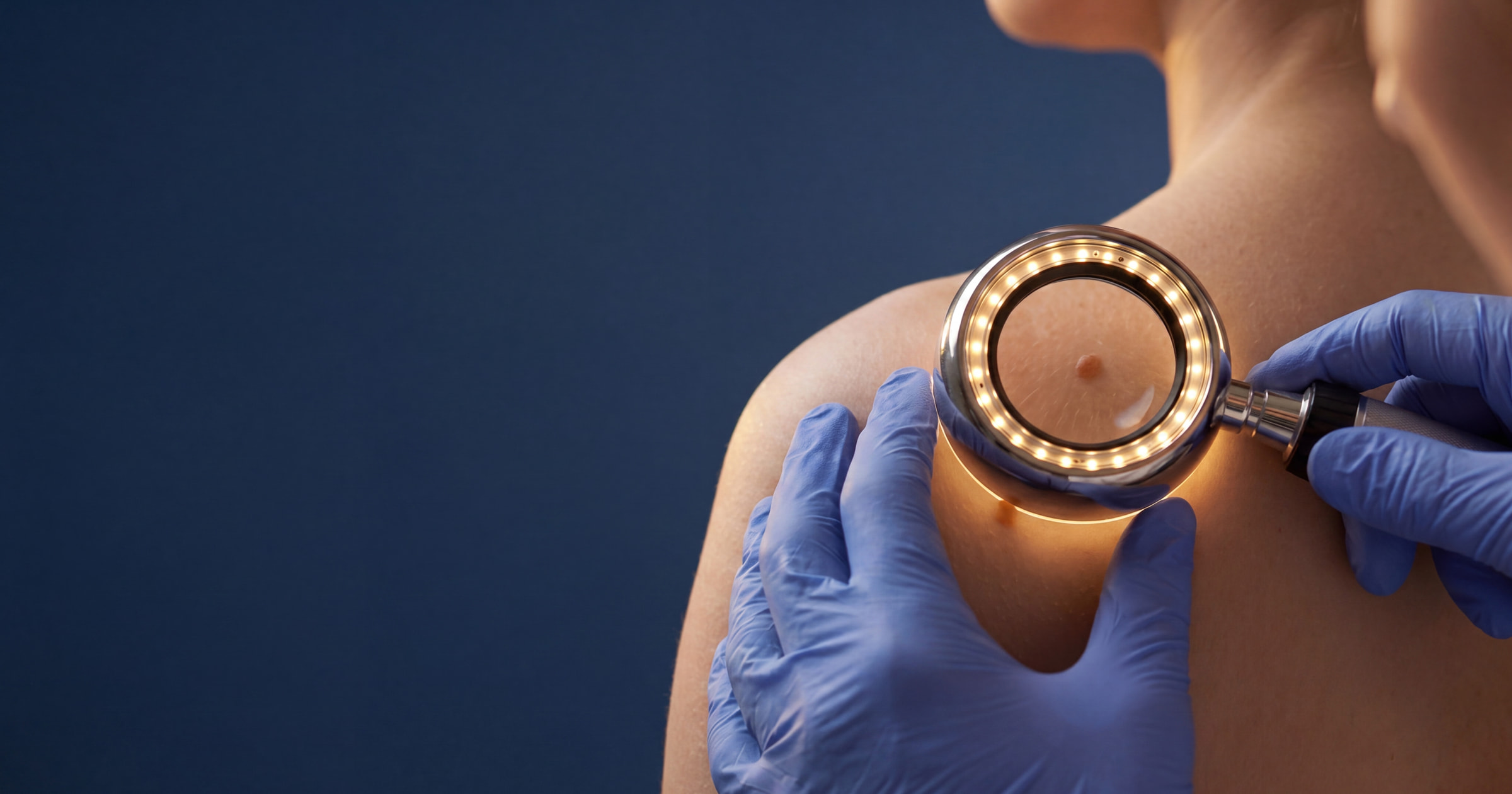
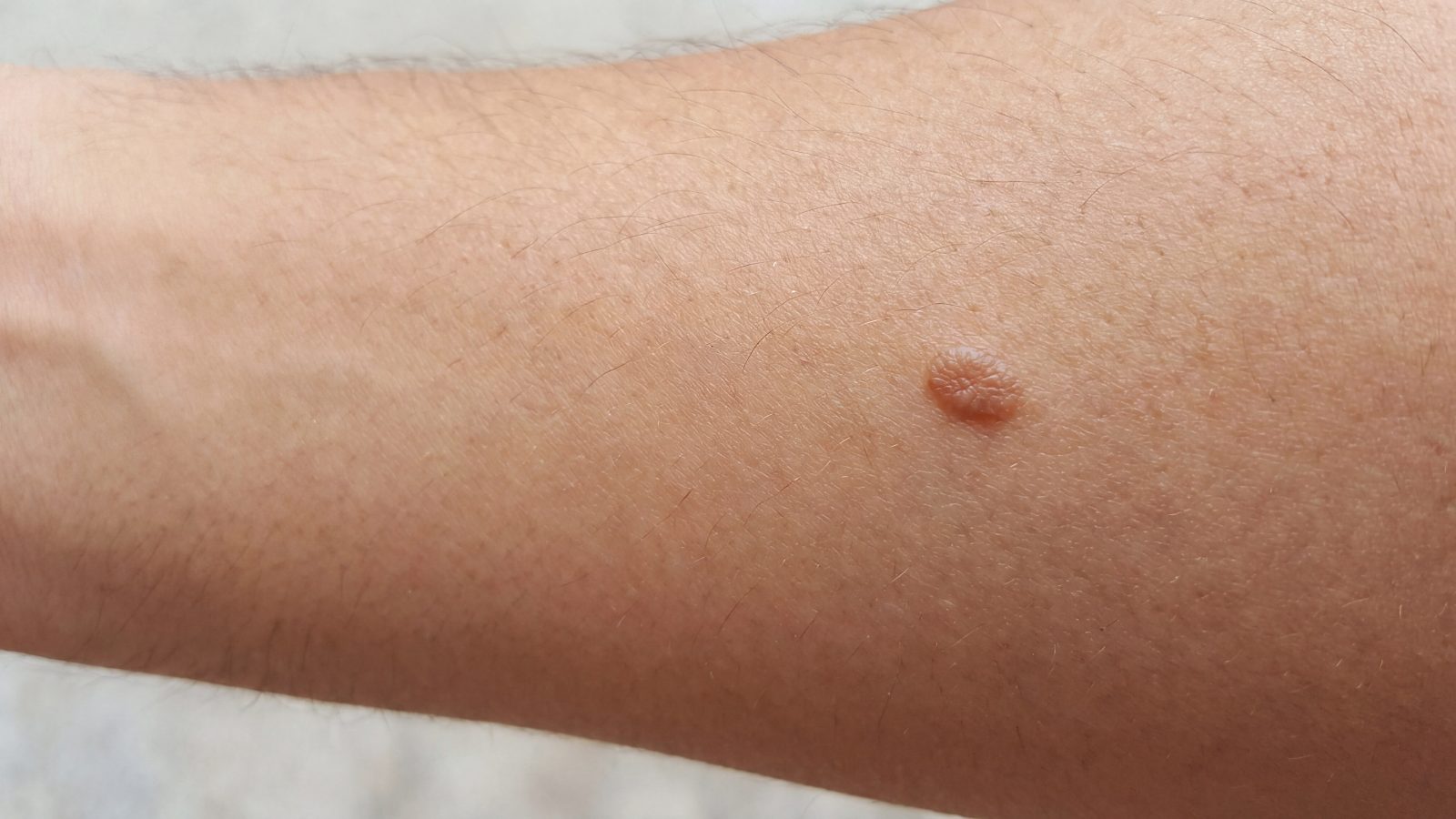
A typical benign mole on the arm: evenly pigmented with a well-defined edge.
Suitability
When mole removal may be considered
Removal of a benign mole may be considered when the lesion is:
Repeatedly catching on clothing, glasses, jewellery or a razor
In a position that causes you persistent self-consciousness (for example on the face or neck)
Cosmetically unwanted, and confirmed benign at consultation
Removal of moles for purely cosmetic reasons is not usually covered on the NHS. We treat adults aged 18 and over and the decision to proceed is made jointly after a careful clinical examination.
Your visit
Assessment and suitability
The consultation is the most important part of the journey. Dr Mugerwa examines the mole using a dermatoscope (a specialised skin magnifier) and asks about its history, including how long it has been there, whether it has changed in size, shape or colour, and whether it bleeds, itches or is painful. We also ask about your personal and family skin-cancer history and sun-exposure pattern.
We only remove moles that we are confident are benign and suitable for private cosmetic removal. If we have any uncertainty, or if the lesion has features that warrant dermatology evaluation, we will not proceed and will refer you back to your GP for NHS assessment. We do not diagnose lesions online; an in-person examination is required.
The procedure
How mole removal is carried out
Two techniques are commonly used. The choice depends on the type of mole, its depth, its location and the cosmetic outcome we expect.
Shave excision. Suitable for some raised, clearly benign moles. The lesion is shaved off level with the surrounding skin under local anaesthetic. No stitches are usually needed and the area is left to heal as a small graze.
Surgical excision with sutures. Used for flatter, pigmented or deeper moles. A small ellipse of skin including the mole is removed under local anaesthetic and the wound is closed with fine sutures.
The procedure itself usually takes 20–40 minutes including consent and dressing. Where it is clinically appropriate to do so, removal of histologically benign-looking specimens may be sent for laboratory analysis (histopathology) as a safety check; this is discussed with you at consultation.
Aftercare
Recovery and aftercare
You can usually drive home and return to most daily activities the same day. We provide written aftercare instructions covering:
Keeping the dressing clean and dry for the first 24–48 hours
When to remove or change the dressing
How to clean the area and signs of infection to watch for
Avoiding strenuous exercise, swimming and saunas during early healing
Sun protection of the healing site to support a better scar
Sutures, where used, are usually removed at 7–14 days depending on the body site. We follow up by phone or in person if needed.
Honest about risks
Risks and limitations
All skin procedures carry some risk. We will discuss the relevant risks for your specific lesion in full at consultation. In general these include:
A permanent scar at the treated site. The aim is to make the scar as inconspicuous as possible, but a visible mark cannot be excluded and we do not promise a scar-free result.
Bleeding, bruising or wound infection
Pigment change in the surrounding skin
Recurrence of part of the mole, particularly after shave excision
Rarely, a lesion that looks benign clinically turns out on histology to be something else, in which case further management or onward referral may be needed
We do not treat children under 18 and we do not treat lesions on the soles of the feet or the palms of the hands.
Important safety information
When to seek urgent assessment
Do not delay NHS assessment for a mole that worries you. Please see your GP urgently, or use NHS 111, if a mole is:
Changing in size, shape, colour or outline
Asymmetrical, has an irregular border, or is multi-coloured
Larger than 6 mm and changing
Itching, bleeding, weeping or forming a non-healing sore
Painful or raised when it was previously flat
These features can be signs of skin cancer including melanoma and need NHS dermatology assessment, not private cosmetic removal.
Ready to take the next step?
Book a consultation in Wirral
Our private clinic in Higher Bebington, Wirral serves patients from across Merseyside, including Liverpool, Birkenhead, Heswall and Chester. We examine the lesion in person before discussing whether removal is the right choice for you.
Assessment, treatment and aftercare, clearly explained.
We know it can feel difficult to book a procedure when you are not sure what will happen next. Your clinician will explain suitability, risks, recovery and aftercare before treatment goes ahead.
Book
Choose a consultation online or speak to the clinic if you are not sure which service fits. Most appointments are available within seven days.
Assess
An in-person review with Dr Mugerwa: he will listen to your story and examine the area, which may include an ultrasound scan. You then get an honest recommendation — if treatment is suitable we explain the options, risks and likely outcomes; if it is not, we will tell you and refer you on.
Treat
The procedure itself, followed by tailored aftercare guidance and a clear contact route if anything changes during recovery.
“I had 9 moles and cysts removed from my face. Procedure and the recovery was painless and 2 weeks later all have healed & scars are fading quickly. I'm very grateful for the care Dr Soul took with me and my face. As well as looking much better physically, this has been a major boost to my self-confidence. Would highly recommend.”
Frequently asked
Your questions, answered
Can you tell me online whether my mole is dangerous?
No. We do not diagnose lesions from photographs or descriptions. A face-to-face consultation with a dermatoscope is needed before we can advise on whether a mole is suitable for private removal or whether it should be reviewed on the NHS.
Will I have a scar?
Any removal technique that breaks the skin will leave some mark. We use techniques chosen to minimise scarring at your specific site, but a permanent scar cannot be ruled out and we cannot guarantee a scar-free result.
Is the mole I have removed sent to a lab?
Where clinically appropriate we may send the removed tissue for histopathology as a safety check. This is discussed and confirmed at consultation.
Do I need a GP referral?
No referral is required for a private consultation. However, if at assessment we feel a mole needs NHS dermatology review, we will recommend that you see your GP for onward referral.
How much does mole removal cost?
Prices depend on the size, type and location of the mole. Our current fees are listed on the pricing page. Insurance cover is uncommon for cosmetic mole removal. Please check with your provider before booking.