

Cyst removalin Wirral.
Surgical removal of suitable benign skin cysts.
- 01Most consultations within 7 days
- 02Higher Bebington · free patient parking
- 03We'll refer you on if we can't help
No obligation · GP-led assessment first · Not ready to book? Meet Dr Mugerwa →
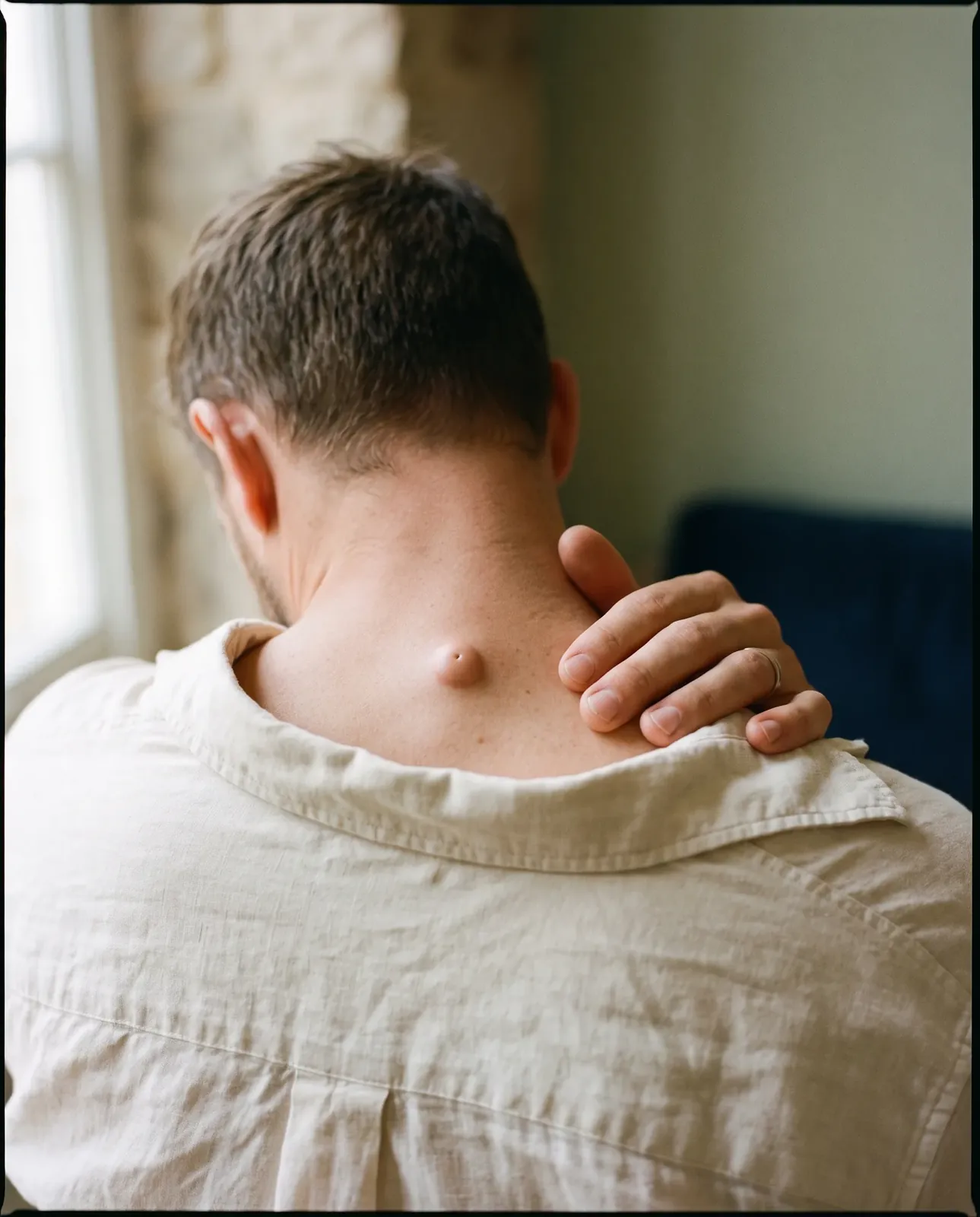
The aim: the cyst and its sac wall, in one piece.
Under local anaesthetic · Wirral
A small, firm lump that you can roll under the fingers is one of the most common reasons patients walk into our clinic.
Most of those lumps turn out to be epidermoid cysts (often called sebaceous cysts), a closed sac of skin containing semi-solid material. They are usually harmless, but a cyst that tugs at a hairbrush, sits inside a shirt collar or has flared up before quickly stops feeling minor.
At our private clinic in Wirral we examine the lump in person, confirm whether it looks like a benign cyst, and explain what removal would involve. Where suitable, surgical excision is carried out in our purpose-built minor surgery suite under local anaesthetic by a GP with special interest in minor surgery.
A closed sac, and why its wall matters.
An epidermoid cyst forms when surface skin cells multiply within a thin sac under the skin instead of shedding normally. The sac slowly fills with keratin, a soft, pale, often cheese-like material. A small central pore is sometimes visible on the overlying skin.
Although the term "sebaceous cyst" is widely used, most of these lumps are actually epidermoid cysts. Other related cysts include pilar (trichilemmal) cysts, which are most common on the scalp. Treatment is similar but the assessment is tailored to the cyst type and location.

Inside a skin cyst.
- 1Central pore: a small central pore is sometimes visible on the overlying skin.
- 2Sac wall: a thin sac under the skin, where surface skin cells multiply instead of shedding normally.
- 3Keratin: the soft, pale, often cheese-like material that slowly fills the sac.
The wall is the cyst.
The aim is to remove the cyst together with its sac wall in one piece, because any retained sac can lead to recurrence.
Recurrence is uncommon when the cyst is removed intact with its sac wall, but it remains possible, especially if the cyst has previously been infected or has burst. Scarring can make complete removal more difficult.
Carefully dissected free.
A small elliptical incision is made over the cyst, the cyst sac is carefully dissected free and removed, and the wound is closed with fine sutures and a dressing applied.
Pilar cysts have a tough, well-formed wall, so they typically "shell out" cleanly and intact, which keeps the incision small and makes recurrence unlikely.
Scalp cysts, shelled out cleanly.
A pilar cyst (also called a trichilemmal cyst) is a smooth, firm, dome-shaped lump that forms around a hair root, which is why nine out of ten appear on the scalp. They often run in families, are more common in women, and can occur as more than one cyst at a time. Most cause no harm, but a scalp cyst that catches on a hairbrush, shows through thinning hair or keeps getting knocked is a daily irritation that patients across Wirral and Merseyside frequently ask us to sort out.
Removal at our Higher Bebington clinic is straightforward. After a GP-led assessment with Dr Mugerwa to confirm the diagnosis, the area is numbed with local anaesthetic and the cyst is removed through a small incision, usually without shaving the surrounding hair. Pilar cysts have a tough, well-formed wall, so they typically "shell out" cleanly and intact, which keeps the incision small and makes recurrence unlikely. The wound is closed with fine sutures, scalp wounds generally heal quickly, and where clinically appropriate the cyst is sent for histology as a safety check.
When a cyst stops feeling minor.
Removal is often considered when a cyst is:
Slowly enlarging
Repeatedly becoming red, sore or inflamed
Discharging foul-smelling material
Located somewhere that catches on clothing or jewellery
Cosmetically prominent, for example on the face or hairline
Causing discomfort when you lie or lean on the area
Settle it first, remove it later.
We do not treat actively infected or abscessed cysts privately. These are best managed first by your NHS GP with antibiotics or incision and drainage. We can usually offer planned excision once the inflammation has settled.
- 01
Infected now
An actively infected cyst is best managed first by your NHS GP, typically with antibiotics or simple incision and drainage.
- 02
Inflammation settles
We wait until the inflammation has settled before planning removal.
- 03
Planned excision
Once the inflammation has settled we can usually offer planned excision a few weeks later.
Please seek urgent NHS assessment from your GP or NHS 111 for any lump that is hot, very painful or discharging pus, alongside fever.
First, confirm it is a cyst.
The consultation focuses on confirming that the lump is compatible with a benign epidermoid or pilar cyst, and on checking that the location and condition of the cyst are suitable for outpatient excision. We examine the lump, ask about its history, and consider any prior episodes of infection.
Suitability for private removal is determined at consultation. Cysts that are:
- very large,
- deeply attached,
- near important structures (for example close to the eye, lip, major nerves or vessels),
- or where the diagnosis is uncertain
may not be suitable for outpatient excision and may be better managed under NHS dermatology or surgical services.
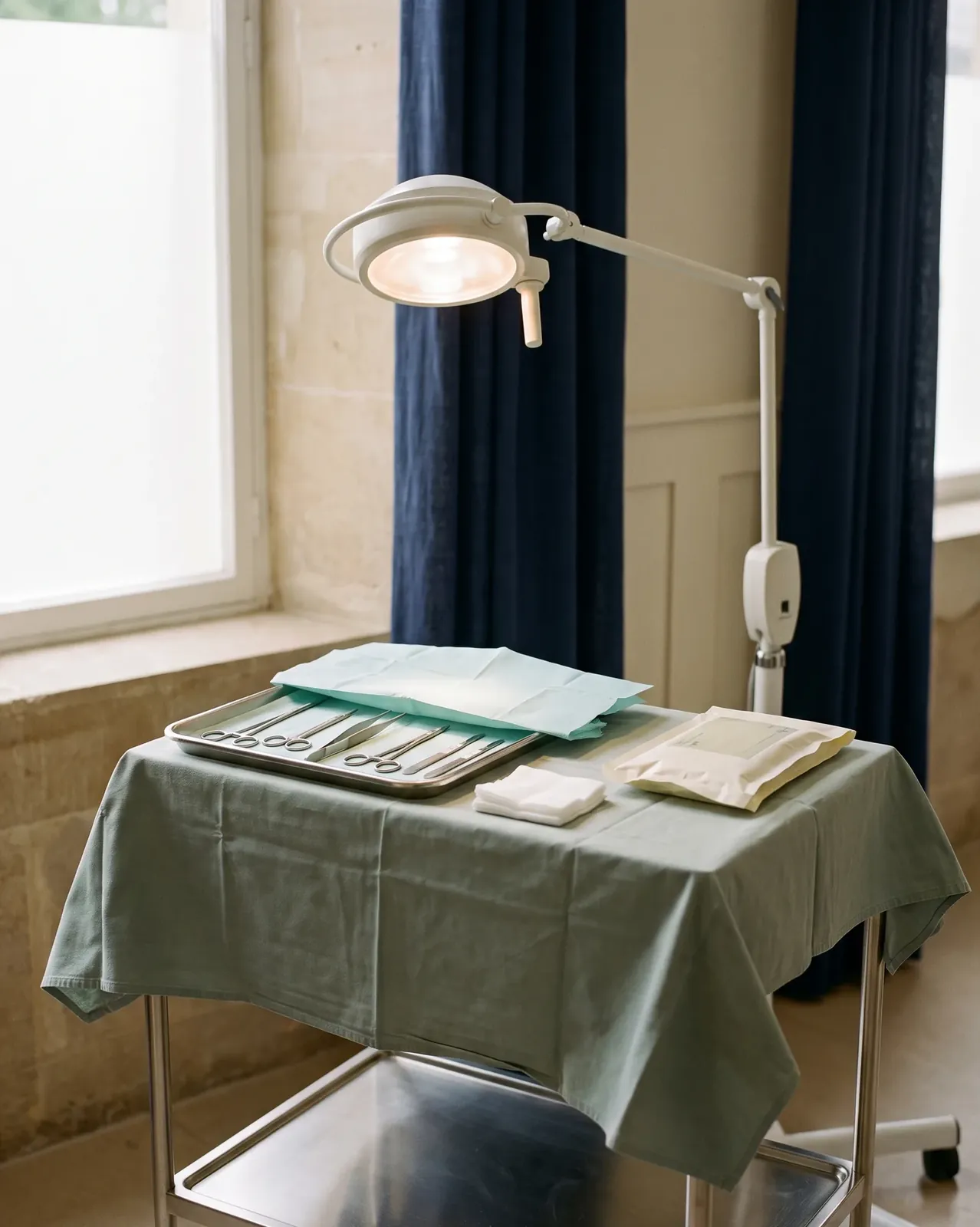
Five careful steps, one piece.
The aim is to remove the cyst together with its sac wall in one piece, because any retained sac can lead to recurrence. The procedure is performed under local anaesthetic in our minor surgery suite.
- The area is cleaned and a sterile drape applied
- Local anaesthetic is injected around the cyst to numb the skin
- A small elliptical incision is made over the cyst
- The cyst sac is carefully dissected free and removed
- The wound is closed with fine sutures and a dressing applied
A typical excision takes 30–45 minutes. Where it is clinically appropriate, the removed tissue may be sent for histopathology as a safety check; this is discussed with you in advance. How histology works →
Local anaesthetic is used to numb the area for the procedure. You will feel pressure but should not feel sharp pain.
Back to your desk, usually the next day.
Most people return to office-based work the next day. Sutures are typically removed at 7–14 days depending on the body site. Scalp wounds tend to heal a little more quickly than wounds on the back or chest.
We provide written aftercare instructions covering:
- Keeping the dressing clean and dry for the first 24–48 hours
- How and when to change the dressing
- Pain relief: paracetamol is usually sufficient
- Avoiding heavy lifting, contact sport, swimming and saunas while healing
- Signs of infection (increasing redness, warmth, swelling, discharge, fever)
Timings vary with the size and site of the cyst. We aim for a fine line scar but cannot guarantee a scar-free result.
An honest account of the risks.
As with any minor surgical procedure, there are some risks. These will be discussed in full at consultation. The main ones to be aware of are:
- A permanent scar. We aim for a fine line scar but cannot guarantee a scar-free result
- Recurrence of the cyst, particularly if part of the sac wall cannot be removed safely (more likely in previously infected cysts where scarring distorts the anatomy)
- Bleeding, bruising or wound infection
- Temporary numbness around the wound
- Rarely, an unexpected histology result requiring further management
Please seek urgent NHS assessment from your GP or NHS 111 for any lump that is:
- Rapidly enlarging over days or weeks
- Hard, fixed to deeper tissue, or growing on bone
- Associated with unexplained weight loss, night sweats or feeling generally unwell
- Hot, very painful or discharging pus, alongside fever
- Pulsating, or with overlying skin changes such as ulceration
Not every lump is a cyst, and rapidly changing or systemically unwell features need NHS review rather than private removal.
Standard cyst removal in Wirral.
Includes consultation, the procedure itself, sutures where needed and aftercare. £200 for each additional lesion in the same session. Facial cyst removal is £650.
Cyst removal
Consultation, procedure, sutures where needed and aftercare- Under local anaesthetic
- In our minor surgery suite
- Written aftercare instructions
Facial cyst removal
Cysts on the face- Examined in person first
- Under local anaesthetic
- Written aftercare instructions
Each additional lesion
Removed in the same session- £200 for each additional lesion in the same session
Pricing depends on the size and location of the cyst and the complexity of removal. Further staining or specialist examination may incur additional cost, which will be explained before proceeding.
Absolutely top service from start to finish I've had multiple cysts removed in the past, but this is by far the best surgery, scars are extremely minimal and there was zero pain afterwards. After care has been great I've been contacted two or three times if needed for further surgery in the future I wouldn't hesitate to go back.
Book a consultation in Wirral.
Our private clinic in Higher Bebington, Wirral serves patients from across Merseyside, including Liverpool, Birkenhead, Heswall and Chester. We examine the lesion in person before discussing whether removal is the right choice for you.
Assessment, treatment and aftercare, clearly explained.
We know it can feel difficult to book a procedure when you are not sure what will happen next. Your clinician will explain suitability, risks, recovery and aftercare before treatment goes ahead.
Book
Choose a consultation online or speak to the clinic if you are not sure which service fits. Most appointments are available within seven days.
Assess
An in-person review with Dr Mugerwa: he will listen to your story and examine the area, which may include an ultrasound scan. You then get an honest recommendation: if treatment is suitable we explain the options, risks and likely outcomes; if it is not, we will tell you and refer you on.
Treat
The procedure itself, followed by tailored aftercare guidance and a clear contact route if anything changes during recovery.
Your questions, answered.
The questions patients most often ask us about cyst removal.
Can a cyst come back after removal?
Recurrence is uncommon when the cyst is removed intact with its sac wall, but it remains possible, especially if the cyst has previously been infected or has burst. Scarring can make complete removal more difficult.
Can you remove cysts on the scalp (pilar cysts)?
Yes. Pilar (trichilemmal) cysts of the scalp are one of the most common lumps we remove at our Wirral clinic. They are removed under local anaesthetic through a small incision, usually without shaving the surrounding hair. Because pilar cysts have a tough, well-formed wall they typically come out intact, which keeps the incision small and makes recurrence unlikely. Scalp wounds tend to heal quickly and sutures are usually removed at around 7 days.
What if my cyst is currently infected?
An actively infected cyst is best managed first by your NHS GP, typically with antibiotics or simple incision and drainage. Once the inflammation has settled we can usually offer planned excision a few weeks later.
Is removal painful?
Local anaesthetic is used to numb the area for the procedure. You will feel pressure but should not feel sharp pain. Afterwards there is some tenderness for a few days, which is usually managed with simple painkillers such as paracetamol.
How long does the procedure take?
A typical outpatient excision takes 30–45 minutes including consent, anaesthetic, removal, closure and dressing.
How much does cyst removal cost?
Pricing depends on the size and location of the cyst and the complexity of removal. Current fees are on the pricing page.
Mole removal
Private removal of suitable benign moles, following clinical assessment to confirm a non-cancerous lesion.
→ 02Lipoma removal
Surgical excision of suitable subcutaneous lipomas (benign fatty lumps) following clinical review.
→ 03Skin tag removal
Removal of suitable skin tags from common sites including the neck, eyelids, underarms and groin.
→ 04Seborrhoeic keratosis
Treatment of suitable seborrhoeic keratoses, common benign 'stuck-on' lesions often seen with age.
→